
Use case · Getting paid
The polite payment follow-up you keep putting off
The job's done, the customer was lovely, and the invoice is two weeks overdue. You don't want to sound like a debt collector — so you send nothing, and the money sits in someone else's account.
Last updated 2026-07-11 · Reviewed by the TradieCue team
Nice customers pay late too
It's not the difficult customers who quietly wreck your cash flow — you chase those without guilt. It's the friendly ones. The fence job went well, they made you coffee, they said “we'll sort the invoice this week”. That was two and a half weeks ago. Now every day you don't follow up feels slightly less awkward than the day you finally do.
Meanwhile the maths doesn't care about awkward. That's your money funding their household instead of your materials, and the longer an invoice sits, the harder it is to collect. Most late payment from good customers isn't refusal — it's drift. The invoice slipped down their inbox. A friendly nudge fixes drift; the problem is that writing a nudge that's firm-but-not-rude at 8pm is exactly the kind of admin that doesn't happen.
Say the situation, get the words
With TradieCue, you describe the situation to Timmy and let it find the tone:
“Follow up the Harris invoice — the fence job, $3,850, it was due on the 27th so it's about two weeks over. They're good people, keep it friendly, just remind them and pop the bank details in again.”
Payment follow-up — Harris fence job
Sample note for illustration. Your draft stays fully editable, and it isn't sent to anyone until you share it.
Thirty seconds of talking, and the awkward part — finding words that are warm and still clearly about money — is done. The amount is the one from your invoice; Prices come from the user and stay editable. Timmy structures the work and wording; it does not invent amounts.
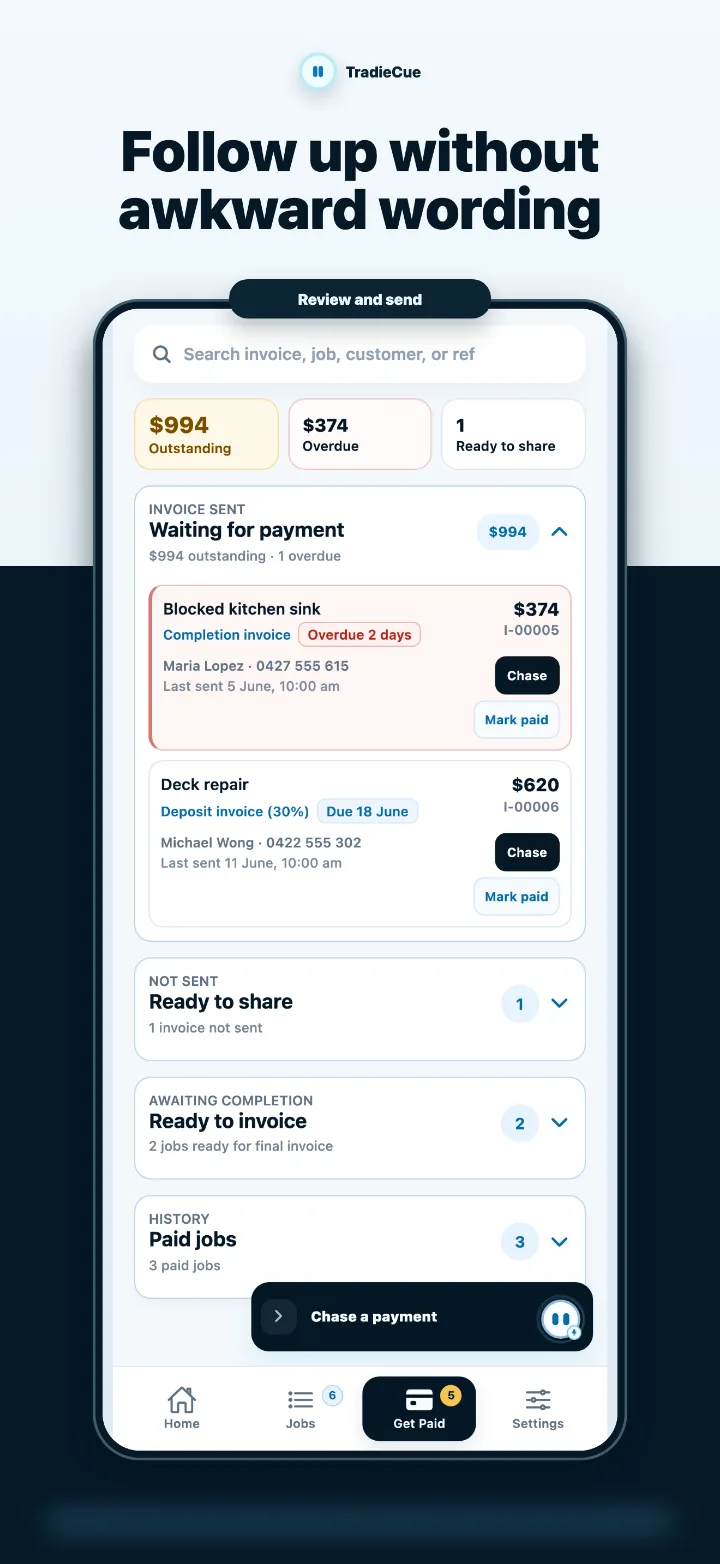
If Timmy's missing a detail, it asks
When an important detail is missing (a price, a customer, a scope item), Timmy asks rather than making it up. On a payment follow-up, that looks like:
- “What's the amount outstanding?” — if you didn't say it, no number gets guessed.
- “When was it due?” — “about two weeks over” works, but a real due date reads better.
- “Which job is this for?” — if the customer has more than one invoice with you.
Your check before sending
Nothing is sent automatically. Every quote, variation and follow-up is a draft the user reviews, edits and shares themselves. A follow-up is quick to review, but do check:
- Amount and due date match your invoice — a wrong number in a reminder hands the customer a reason to stall.
- The tone matches the relationship — friendly nudge at two weeks; something firmer at six. The draft is editable, so shift it either way.
- Payment details are correct before you re-send them.
Then send it from wherever you normally message them — text, email, whatever the Harrises actually read. And if the friendly one doesn't land? The firmer second and third rounds exist too: same flow, sterner words. The full escalation ladder — timing, wording, when to mention next steps — is in how to follow up an overdue trade invoice, and there's a free payment reminder template if you want ready-made wording to adapt by hand.
The manual alternative
Manually, this is a message you draft in your head for three days. You open the thread, type “Hi Sarah, just checking…”, decide it sounds pushy, delete it, decide silence is worse, retype it, soften it until it no longer clearly asks for money, and send something that reads like an apology. Or — more common — you send nothing and hope the invoice pays itself. Two weeks becomes six.
A template helps with the words but not the friction: you still have to find it, fill in the names and numbers, and adjust the tone yourself, per customer, per round. Talking the situation out flips the effort — you spend your thirty seconds on what you know (the job, the customer, how overdue, how friendly) and review the result instead of writing from a blank box. That's the payment follow-ups feature; it also slots neatly into an end-of-day admin sweep.
Common questions
Does TradieCue send the reminder to my customer?
No. Timmy drafts the message; you review it, edit it and send it yourself through whatever channel you normally use. Nothing contacts your customer automatically.
What if a friendly reminder doesn't work?
Escalate with the same flow — tell Timmy it's the second or third follow-up and you want it firmer, and review the tone before sending. The escalation sequence is covered in the overdue invoice guide.
Will Timmy add late fees or interest to the reminder?
Only if you tell it to, and only with figures you provide. Whether you can charge late fees depends on your terms, and drafts aren't legal or accounting advice.
Can it track which invoices are overdue for me?
TradieCue keeps your jobs and follow-up drafts in one place, but it isn't accounting software — it doesn't sync your ledger or lodge BAS. You tell Timmy which invoice to chase and it drafts the words.
Try it on your next job
TradieCue is free to download on the App Store. Say a rough note about a real job and review the draft Timmy produces — nothing is sent until you share it yourself.
Free to download and try. TradieCue Pro is a subscription through Apple: A$24.99/month or A$239.99/year with a 30-day free trial. Apple confirms before any charge.