
Feature · Bilingual
Speak Chinese on site. Quote in professional English.
You can price a job, run a crew and keep a customer happy — in two languages. But the paperwork software only speaks one, and it's not the one you think in at 7pm. TradieCue takes job notes in English, Chinese or the mix you actually talk in, and drafts customer-facing documents in professional English.
Last updated 2026-07-11 · Reviewed by the TradieCue team
The tax on quoting in your second language
For a lot of immigrant tradies, admin isn't slow because the trade knowledge is missing — it's slow because every quote means composing formal English. The trade words come out in English anyway (“splashback”, “rough-in”, “GST”), the rest comes faster in Chinese, and no form field accepts both. So quotes go out late or thin, and late, thin quotes lose to worse tradies with better paperwork. That's the real cost: not embarrassment, money.
Talk the way you actually talk
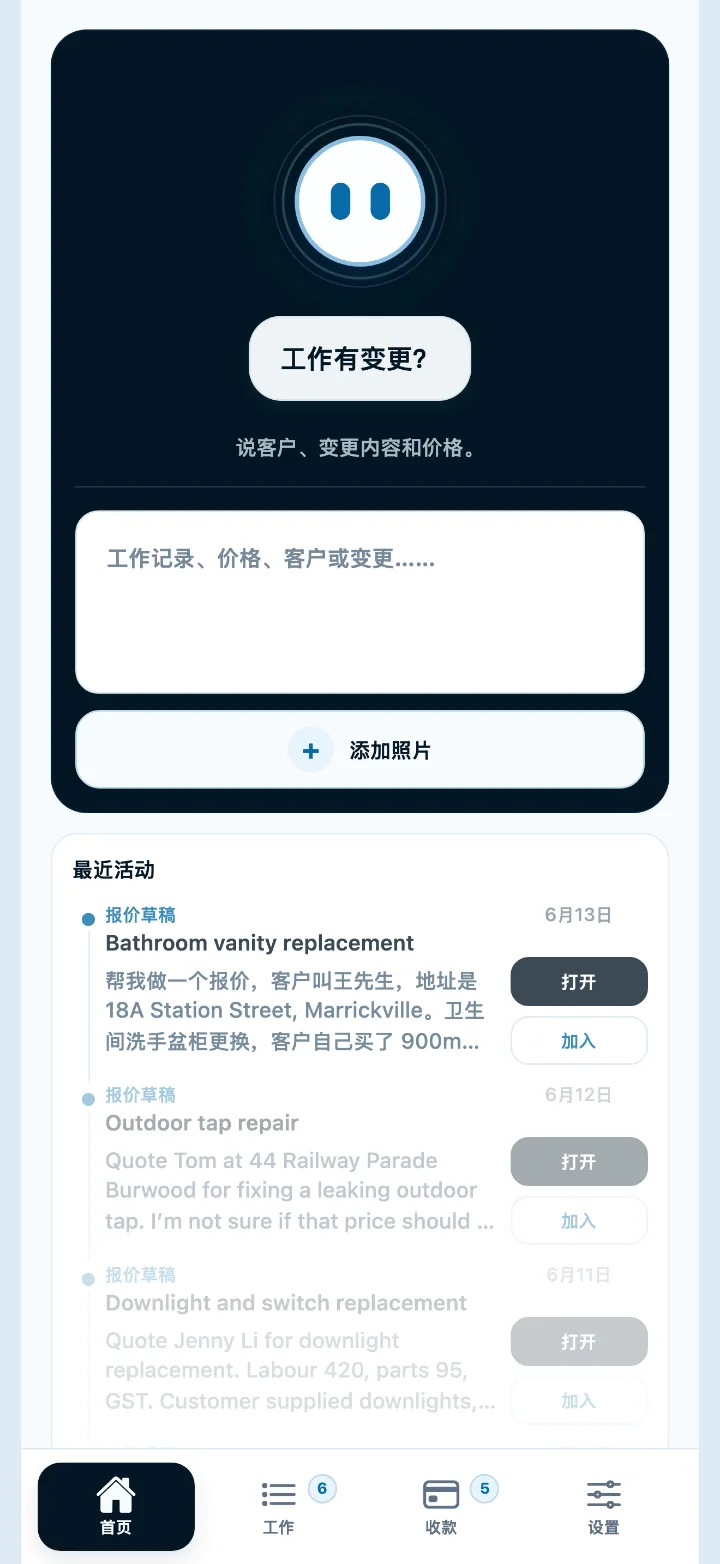
There's no language toggle to set. Say the note in English, in Chinese, or switching mid-sentence the way site conversations really go:
“Mrs Chen's job — pull out that kitchen splashback and replace it with a tiled one, about three square metres. Labour and materials $680 plus GST, told her we can start Thursday.”
Spoken mostly in Mandarin, with the trade terms in English — the way the sentence actually comes out on site.
Quote — Kitchen splashback replacement (Mrs Chen)
Sample note for illustration. Your draft stays fully editable, and it isn't sent to anyone until you share it.
The price is the one you said — $680 plus GST becomes $748 inc. GST, no invented numbers. Prices come from the user and stay editable. Timmy structures the work and wording; it does not invent amounts. The scope you described in a mix of Chinese and trade English comes out as line items an English-speaking customer reads without noticing anything unusual, because there's nothing unusual to notice. It's just a professional quote.
You're still the one who checks it
Translation plus drafting is exactly where an error would hurt, so be clear about the deal: you stay responsible for checking the draft — names, scope, quantities and every dollar amount — before it goes anywhere. Every draft is an editable preview, nothing sends automatically, and if a key detail is missing Timmy asks you rather than filling the gap itself. Read it in whichever language you check numbers in; the customer only sees what you approve.
Generated documents are drafts to review — not legal, accounting or tax advice. How the review-first design works — and why it's the whole point — is covered in human-reviewed AI.
Where it pays off most
The splashback quote is the obvious case, but the same capture runs through the paperwork that usually slips when English composition is the bottleneck:
- Mid-job extras. The customer adds work, you agree in whichever language the conversation happens, and the variation draft comes out in English — written down before it's forgotten, which is where the money is.
- Chasing invoices. Explain the situation in Chinese; the payment follow-up your customer receives is polite, firm, professional English.
- Plain site notes. Access details, customer-supplied fixtures, things you told them wouldn't work — captured as job notes on the right job, in whatever mix you spoke them.
What's supported today
Input: English, Chinese, or mixed English-and-Chinese — spoken or typed. Output: customer-facing documents in professional English. That's the honest, released scope; other input languages aren't available yet, and customers can't yet receive documents in Chinese. It's the same job-aware record behind voice to quote, whichever language the note arrived in.
Common questions
Do I need to tell the app which language I'm speaking?
No. English, Chinese or both in the same sentence — say it how it comes out. Mixed notes are expected, not a special mode.
Can my customer receive the quote in Chinese?
Not today. Customer-facing documents come out in professional English. Your notes can be in either language or both.
What if the translation gets a detail wrong?
That's why nothing auto-sends. Every draft is an editable preview and you're responsible for checking names, scope and amounts before sharing — the same check you'd give any quote, in a fraction of the writing time. Prices are never translated into new numbers: Timmy uses the amount you said or asks if you didn't give one.
Does it support Vietnamese, Korean or other languages?
Not yet. Released input languages are English, Chinese and mixed English-Chinese only — we'd rather claim exactly what works.
Is this just a translation app?
No. Translation apps give you English sentences; TradieCue gives you the document — a scoped quote, variation or follow-up draft filed on the right job. See Chinese to English trade quotes for the full workflow.
Try it on your next job
TradieCue is free to download on the App Store. Say a rough note about a real job and review the draft Timmy produces — nothing is sent until you share it yourself.
Free to download and try. TradieCue Pro is a subscription through Apple: A$24.99/month or A$239.99/year with a 30-day free trial. Apple confirms before any charge.