
Use case · Bilingual
Quote in English, even when the job runs in Chinese
Plenty of tilers and renovation subbies run their whole day in Mandarin — suppliers, crew, pricing, all of it. Then the customer asks for a written quote in English, and the hardest part of the job happens at a keyboard.
Last updated 2026-07-11 · Reviewed by the TradieCue team
The work is excellent. The email is the problem.
You can price a bathroom's tiling to the square metre in your sleep. You know exactly what the waterproofing, the substrate prep and the mitred edges are worth. None of that helps at 9pm when the quote has to go out in polished written English, and every sentence takes five minutes and still reads stiff.
The cost isn't just the evening. A quote that reads rough gets treated as rough — some customers quietly mark down the price they'll accept, or pick the builder whose paperwork looked more established, even when your work is better. Your English is fine for running a site; the written-formal register is a different skill, and it's the one the quote gets judged on.
Say it how you actually talk
With TradieCue, you speak the note in whatever comes out — Mandarin, English, or the mid-sentence mix every bilingual tradie actually uses:
“The Chen family's bathroom — wall tiles to the ceiling, 300x600 tiles, floor is 600x600, waterproofing included, two coats. Tiling with labour $6,200, waterproofing $900, plus GST. Finished in two weeks.”
Said in Mandarin, apart from the sizes and the prices — exactly the mix most bilingual tradies speak on site.
Quote — Chen bathroom tiling
Sample note for illustration. Your draft stays fully editable, and it isn't sent to anyone until you share it.
The customer-facing document comes out in professional English regardless of what mix went in. The prices are exactly the ones you said — Prices come from the user and stay editable. Timmy structures the work and wording; it does not invent amounts.
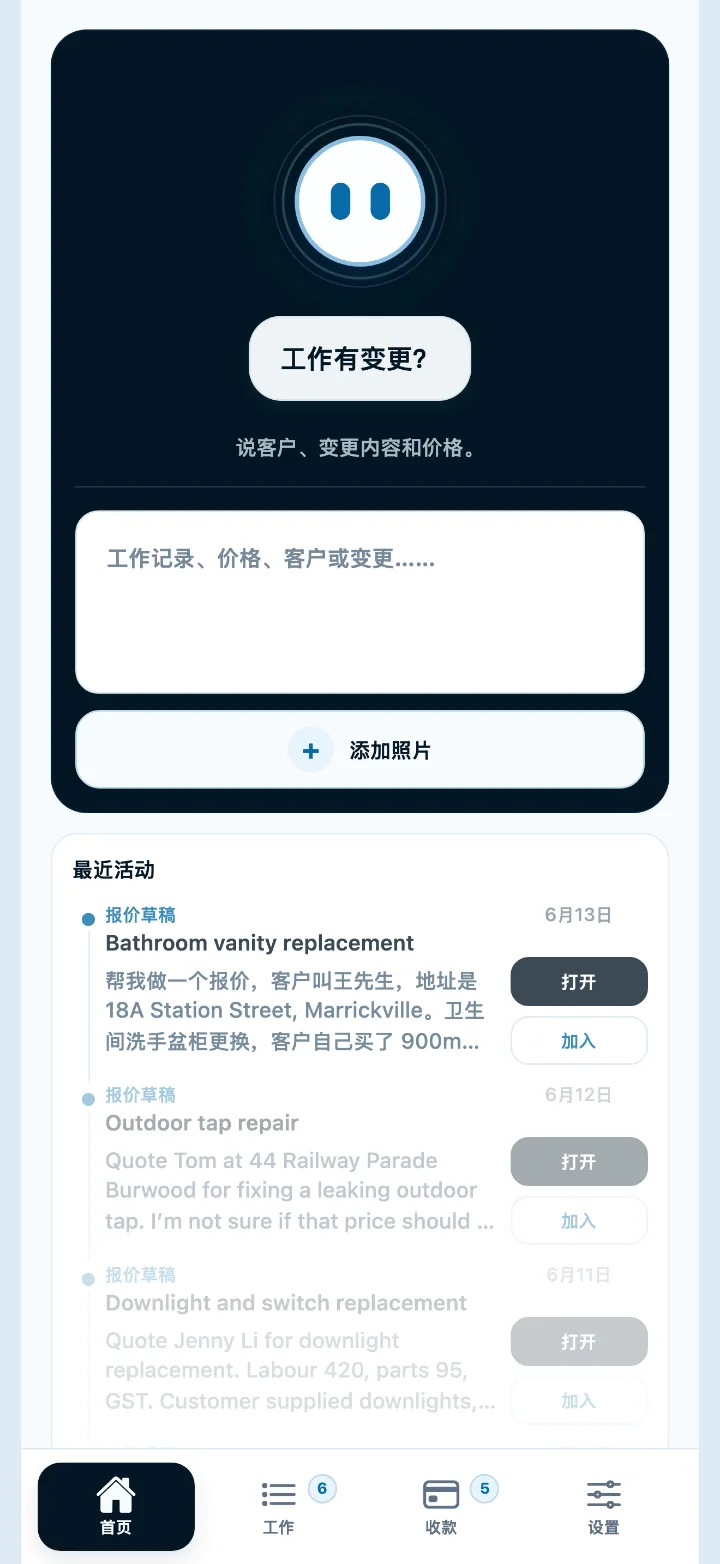
Missing details get asked, in the flow you started
When an important detail is missing (a price, a customer, a scope item), Timmy asks rather than making it up. If your note names the tiles but not the customer, or gives a lump price without saying whether GST is on top, Timmy asks — questions asked in your language, “which customer is this quote for?” level simple: who's it for, what's the amount, is that inc. or ex. GST. Nothing gets invented to fill a gap, because a guessed detail in a quote costs you either money or trust.
You're still the one who checks it
This matters more, not less, when the draft crosses languages. Nothing is sent automatically. Every quote, variation and follow-up is a draft the user reviews, edits and shares themselves. Before sending, read the English draft yourself and confirm:
- The scope says what you meant — the Mandarin phrase for “waterproofing included” came through as exactly that — included — with nothing added or dropped in translation.
- Every amount matches what you said, and the GST treatment is the one you intended.
- Names, address and timing are right.
The draft is fully editable, so fix anything that's off before it goes anywhere. Timmy does the register and the structure; the facts, scope and amounts stay your responsibility to verify.
The manual alternative
The usual workarounds all have a tax. Writing it yourself costs the evening and still reads stiff. A translation app converts your words literally but doesn't know a quote needs line items, GST and terms — you get translated sentences, not a document. Asking a relative with better written English to “fix it up” works until they're busy, and puts your pricing through someone else's phone. All three add days between the walkthrough and the quote, and slow quotes lose jobs in any language.
Speaking the note the way you actually think — Chinese, English or both — and reviewing a structured English draft turns that evening into a few minutes. The capability behind it is bilingual job notes on top of voice-to-quote; the same flow covers variations and payment follow-ups, not just quotes. For what a strong English quote should contain, see how to write a professional trade quote.
Common questions
Which languages can I speak to Timmy?
English, Chinese or a mix of both in the same note. Customer-facing documents come out in professional English. Other input languages aren't supported today.
Can the quote itself be produced in Chinese?
No — customer-facing output is professional English. Your input can be entirely Chinese, but the document your customer sees is an English quote, variation or follow-up.
What if the translation gets a detail of my scope wrong?
That's why every draft opens as an editable preview and nothing sends automatically. You read the English draft, check scope and amounts against what you meant, and correct anything before sharing. You stay responsible for the facts in your quote.
Will Timmy convert my prices or make up amounts?
No. The amounts in the draft are the amounts you said, in dollars, and they stay editable. If a price is missing, Timmy asks instead of guessing.
Try it on your next job
TradieCue is free to download on the App Store. Say a rough note about a real job and review the draft Timmy produces — nothing is sent until you share it yourself.
Free to download and try. TradieCue Pro is a subscription through Apple: A$24.99/month or A$239.99/year with a 30-day free trial. Apple confirms before any charge.