
Use case · Variations
Document building variations before they cost you
Mid-renovation, the client moves the whole bathroom layout. The work changes in one conversation — whether you get paid for it depends on what's written down. Here's how to document the variation while you're still standing in the room.
Last updated 2026-07-11 · Reviewed by the TradieCue team
Tuesday, week three of the reno
You're halfway through a bathroom renovation. The client walks in, looks at the roughed-in plumbing and says: “Actually — can the shower go where the bath was? And we'll skip the bath entirely.” It's a fair request, and you can do it. But it means moving the drainage, relocating two water points, and re-doing part of the waterproofing plan.
Every builder knows how this goes if it stays verbal. The job absorbs the change, the invoice grows, and at handover the client remembers a friendly chat — not an agreement to pay for relocated plumbing. Variations that aren't documented turn into discounts. The fix isn't a better memory; it's writing the variation down at the moment the layout changes, not at the end of the week.
Say it while the client is still in the room
With TradieCue, documenting the variation is one rough note to Timmy — spoken or typed:
“Nguyen bathroom reno — client's changed the layout, shower moves to the bath wall and the bath is deleted. Need to relocate the floor waste and two water points, extend the hot and cold runs, and redo the waterproofing layout for the new shower position. Call it $2,400 plus GST, and it adds three days.”
Variation — Nguyen bathroom renovation
Sample note for illustration. Your draft stays fully editable, and it isn't sent to anyone until you share it.
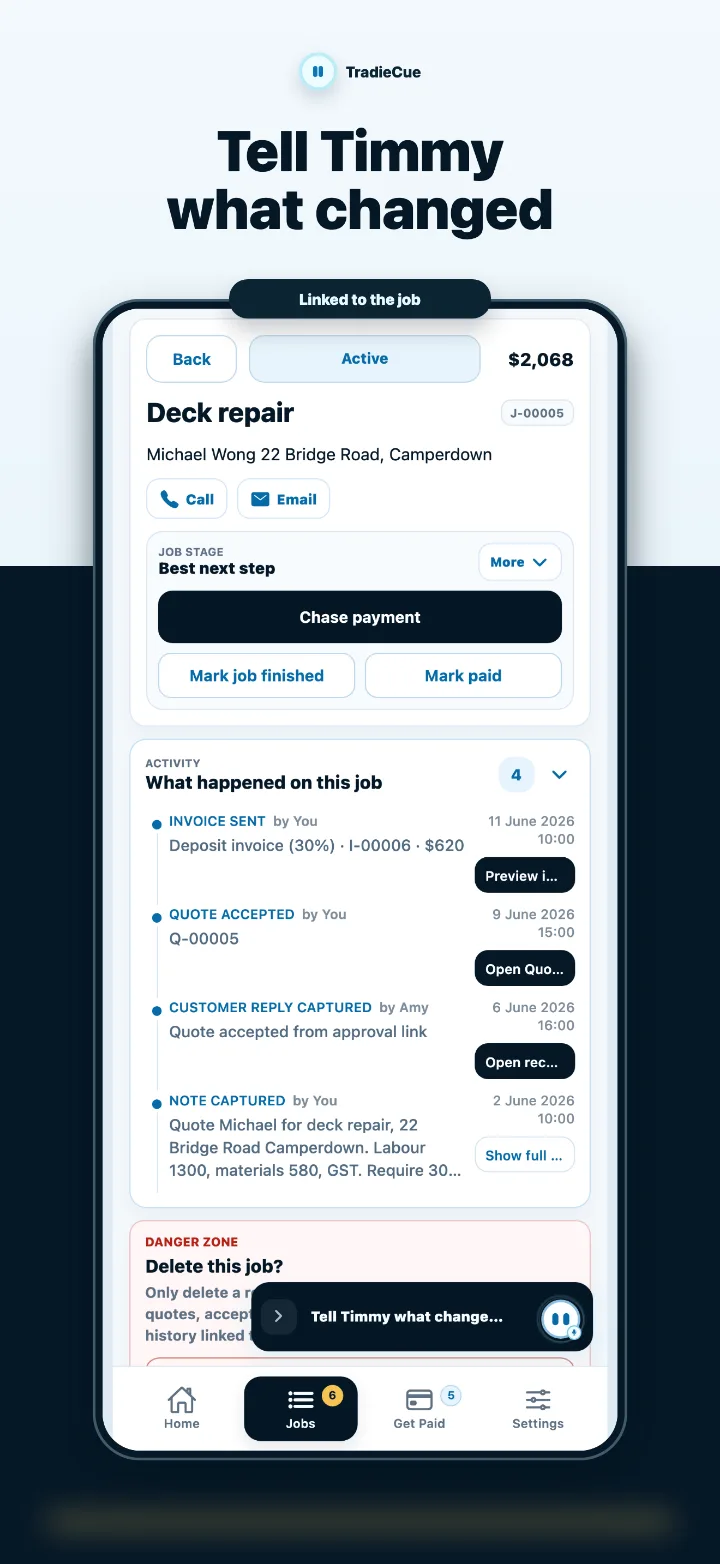
The draft lands on the Nguyen job, next to the original quote — not in a loose note you have to find again. Your price is the one you said: Prices come from the user and stay editable. Timmy structures the work and wording; it does not invent amounts.
If details are missing, Timmy asks
When an important detail is missing (a price, a customer, a scope item), Timmy asks rather than making it up. On a layout change like this, that usually means questions like:
- “What's the price for this variation?” — if you described the work but hadn't landed a number yet.
- “Which job is this for?” — if the note could match more than one open job.
- “Does the deleted bath come off the original price?” — if you mentioned removing scope without saying what happens to the money.
The variation draft holds the scope either way. A documented change with the price marked “to be confirmed” still beats a perfect number that never got written down.
What you check before it goes out
Nothing is sent automatically. Every quote, variation and follow-up is a draft the user reviews, edits and shares themselves. Before you share a building variation, the two-minute review that matters:
- Scope matches what was agreed — including what's now excluded (the bath, in this case).
- The amount and GST treatment are right, and any credit for deleted work is stated.
- Time impact is mentioned if the change moves your completion date.
- It reads like something the client can approve — one clear scope, one clear number.
Then share it and get the client's yes in writing before the drainage moves. What a formal variation should contain — and when you want a signature rather than a text back — is covered in what to include in a building variation.
The manual alternative
Without an assistant, documenting this variation properly means: remember it until the evening, find the variation template, retype the job and client details, reconstruct the scope from memory, price it, format it, and email it — while the client's enthusiasm for paying extra cools by the day. Most builders skip a step; many skip the whole thing on “small” changes, and small changes are exactly the ones that stack up unbilled.
The template still has its place — some builders like paper, and it's free. But the version of you standing in the half-demolished bathroom doesn't need a template, it needs the variation captured now. That's the whole use case: the writing-down happens at the moment of agreement, and the polishing takes two minutes instead of an evening. For the broader habit — hidden damage, client requests, all the extras — see how to document extra work and the variation capture feature itself.
Common questions
Does the variation get sent to my client automatically?
No. Timmy drafts it on the right job; you review, edit and share it yourself. Nothing goes to a client until you send it.
What if the layout change also removes work from the original quote?
Say so in your note — for example “bath is deleted, credit $600”. The draft reflects what you said, and you confirm the numbers in the editable preview before sharing. Timmy won't invent a credit you didn't state.
Do I need the client's signature on a building variation?
That depends on your contract and your state's building rules — for larger residential jobs a signed variation is often required, and TradieCue drafts aren't legal advice. Practically: any written, priced variation the client acknowledged beats a verbal agreement, whatever your contract says.
Can I document a variation in Chinese?
Yes — speak English, Chinese or a mix, and the customer-facing variation comes out in professional English. See bilingual job notes.
Try it on your next job
TradieCue is free to download on the App Store. Say a rough note about a real job and review the draft Timmy produces — nothing is sent until you share it yourself.
Free to download and try. TradieCue Pro is a subscription through Apple: A$24.99/month or A$239.99/year with a 30-day free trial. Apple confirms before any charge.